Inside Ayutthaya: A Temple-by-Temple Guide to the Historical Park
The short answer
Take the island in this order: Wat Mahathat and Wat Ratchaburana, which face each other across one road; then Wat Phra Si Sanphet with Wihan Phra Mongkhon Bophit beside it; then Wat Lokayasutharam in the west. Cross to Wat Chaiwatthanaram at the end of the afternoon, and pick up Wat Yai Chai Mongkhon and Bang Pa-In Royal Palace on the drive out if your day includes them.
Why this is a walking order, not a floor plan
A guide to a palace or a museum goes room by room. Ayutthaya has no inside: it is a ruined city of separate monasteries spread over an island, and the useful question is not what is in each building but which order to take them in. Get the order right and the walking almost disappears; get it wrong and you will cross the same ground three times.
Everything below is in that order, with the two outliers at the end. Where each one sits is on the map and layout page.
Wat Mahathat, and the head in the tree
Built in 1374 by King Borommarachathirat I to house a jewelled reliquary, and enlarged in 1384 by his nephew Ramesuan, who gave it the name it still carries. The central prang is a stump now, and the cloister walls carry rows of seated Buddhas with their heads gone.
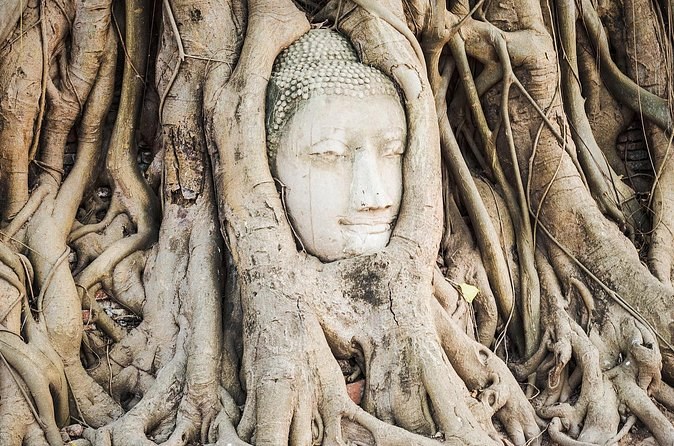
The reason everyone comes is a sandstone Buddha head held about a metre off the ground in the roots of a bodhi tree. Crouch or kneel to photograph it — the rule is signposted and staff enforce it, so that your own head is never above the Buddha's.
Wat Ratchaburana, and the duel that built it
Directly across the road, and skipped by a surprising number of tours. King Borommarachathirat II founded it in 1424 on the cremation site of his two elder brothers, who had fought each other to death over the succession to their father Intha Racha.
The prang still carries much of its stucco, which makes it the best place in the city to see what these towers looked like finished. Beneath it is a crypt, reached by steep stairs, holding faded frescoes that are among the rare survivals of early Ayutthaya painting. It is also where thieves broke in during 1957; the official excavation that followed recovered more than 100,000 votive tablets and over a hundred kilograms of gold.
Wat Phra Si Sanphet, the royal temple
Three restored chedi in a row, and the silhouette on every photograph of the city. The ground was the first royal palace, built by U Thong in 1350; in 1448 Borommatrailokkanat moved the palace north and made this a holy site used by the royal family alone, with no resident monks.
Each chedi holds a king. The first two were raised in 1492 by Ramathibodi II for his father and his brother; the third came in 1529 for Ramathibodi II himself. Walk the row east to west and you are walking down a family in order. Full detail is on the Wat Phra Si Sanphet page.
Wihan Phra Mongkhon Bophit, the one with a roof
Immediately south, and the only large building on the island you can go inside. The hall is a modern restoration around a very old bronze Buddha, one of the largest in Thailand, and after an hour of open ground the dark interior is a genuine shock.
People come here to make offerings rather than to sightsee, so keep your voice down and take your shoes off where the signs ask. The market stalls outside are the best place on the island to buy roti sai mai.
Wat Lokayasutharam, free and quiet
West of the centre, a ruined monastery whose reclining Buddha survives in the open air on a platform with no building around it. There is no ticket booth. You will usually find incense and flowers left along its length by local visitors, and far fewer people than anywhere in the centre.
Because it is free and slightly off the main circuit, some short tours skip it. Check your itinerary if you want it.
Wat Chaiwatthanaram, across the river
King Prasat Thong's temple of 1630, built in Khmer style on the west bank of the Chao Phraya River. A 35-metre central prang, four smaller prangs around it, and eight chedi-shaped chapels joined by a cross-shaped passage that once held 120 seated Buddha images.
Walk the passage rather than cutting across the middle: it is the route the plan was drawn for. And come late — it faces the water, which is why every sunset itinerary ends here. The full account is on the Wat Chaiwatthanaram page.
The two you reach by car
| Site | Where | What it adds |
|---|---|---|
| Wat Yai Chai Mongkhon | Beyond the rivers, south-east | The tallest chedi in the city, raised by King Naresuan in 1592, ringed by sashed Buddhas — and you can climb it |
| Bang Pa-In Royal Palace | About 20 km south | An intact royal site: painted pavilions, a Chinese throne hall and a lake pavilion, mostly built 1872–1889 |
Neither is part of the archaeological park, and both are the reason some days run to nine hours rather than seven. Which tours reach which is compared across the Ayutthaya temple tour listings.
How long the whole circuit takes you
If you walk the island core — Wat Mahathat, Wat Ratchaburana, Wat Phra Si Sanphet and Wihan Phra Mongkhon Bophit — you will spend about two and a half hours including the walking between them. Add Wat Lokayasutharam in the west and you are at three. Cross the river for Wat Chaiwatthanaram and you are at four, plus the crossing itself.
That is the arithmetic behind every itinerary you will compare. A seven-hour day trip from Bangkok leaves about three and a half hours on the ground once the driving is taken out, which is the island core plus one. A nine-hour private day buys you the river crossing or the royal palace, but rarely both without rushing. The times each listing states are on planning a visit.
Three things people walk straight past
- The palace platforms behind Wat Phra Si Sanphet. Low brick outlines, clear enough to read as rooms, and the quietest ground inside the ticketed area.
- The empty wihan beside those chedi, where a sixteen-metre Buddha carrying 343 kg of gold once stood. Stand in the middle and look up.
- The cloister walls at Wat Mahathat, where the rows of headless seated Buddhas say more about 1767 than any signboard.
What happened to all of them in one April afternoon is on the history of Ayutthaya.
Eight monuments, one island and a river to cross. Take them in the order above and a day here stops feeling like a scramble between car parks. The days that reach the most of them are set out on Ayutthaya Tours.
Days that reach the most of these
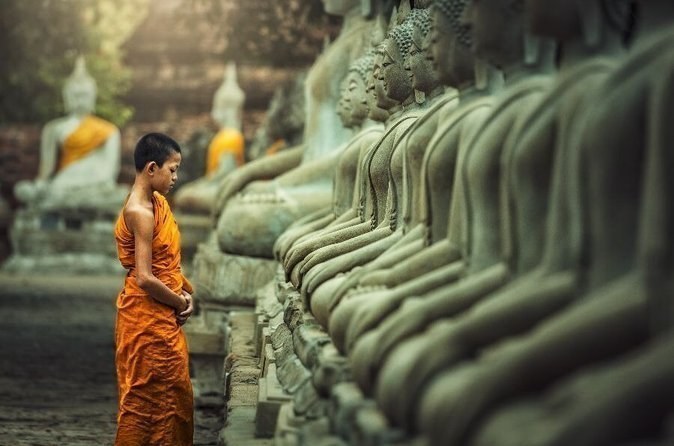
Bangkok: Private Ayutthaya and Bang Pa-In Summer Palace Tour
Bang Pa-In Royal Palace in the morning, the ruins after lunch, private car.
From $176 per person
Check Availability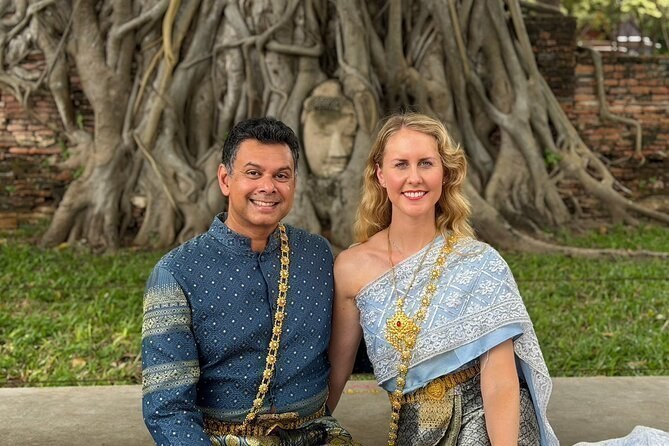
Private Excursion to Ayutthaya, UNESCO World Heritage site with Boat Tour
A private boat around the historical park, four temples and Thai desserts.
From $152 per person
Check Availability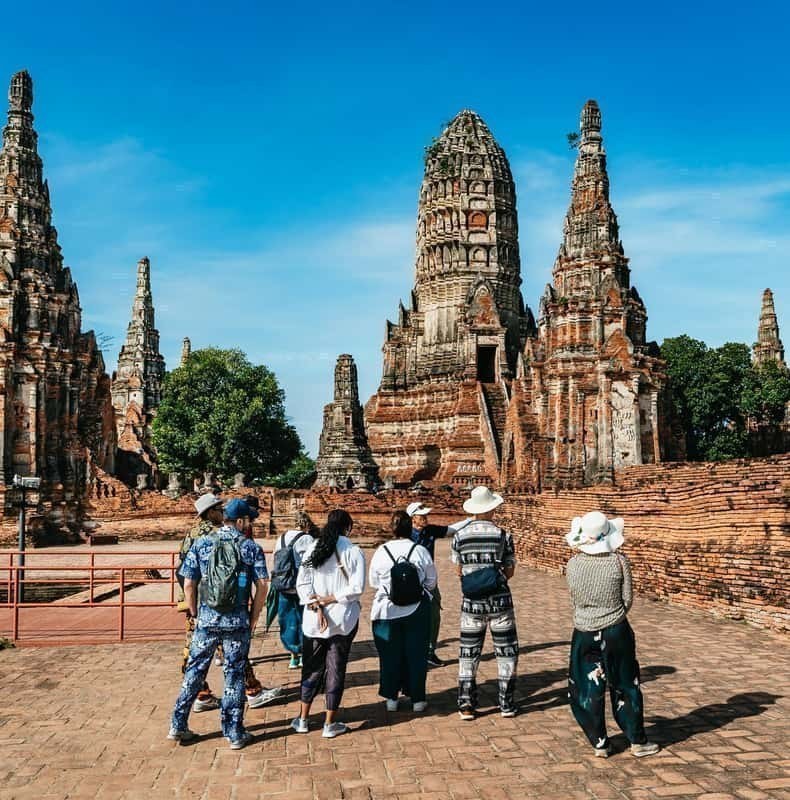
From Bangkok: Ayutthaya Temples Guided Tour with Lunch
Four temples, a coach from Bangkok and lunch, at the lowest fare on the list.
From $33 per person
Check Availability